
C drive out of space is a common issue for most Windows computer users. By removing junk files and unnecessary programs, and changing some settings to free up disk space on Windows 10, you can get more free space without buying a new disk. If you cannot clean up enough space, you can expand the C drive with unused space in other volumes without recreating partitions or reinstalling the Operating System.
When freeing up disk space, Windows 10 is more powerful than all previous versions. To better understand how to free up disk space in Windows 10 computers, the methods are divided into 4 parts.
1. Free Up Space with Windows 10 Disk Cleanup
Disk Cleanup is a Windows native included maintenance utility that is used to free up disk space on hard disk drives. The utility is easy and fast; it searches the hard drive for files that are no longer used, analyzes them, and removes unnecessary and junk files safely. Windows 10 Disk Cleanup can delete many types of files, such as Windows Updates, Temporary files, Logs, Cache, and files in the Recycle Bin.
Windows 10 Disk Cleanup can free up space via the command prompt or with a step-by-step wizard. There are several ways to launch this utility; here is the easiest way.
Steps to free up space with Windows 10 Disk Cleanup:
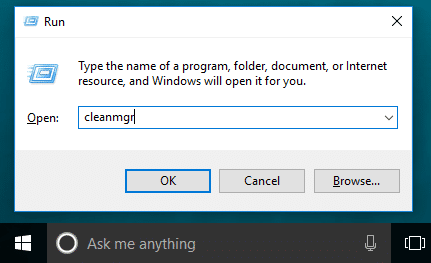
Step 1: Press Windows and R on the keyboard, type cleanmgr and press Enter.
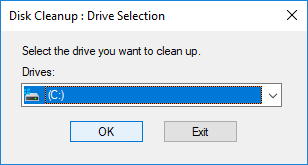
Step 2: Select C: drive or any other one from the drop-down list and click OK.
Step 3: Check the boxes next to the files that you want to remove. Read the associated description at the bottom before clicking OK if you do not know what these files are about.
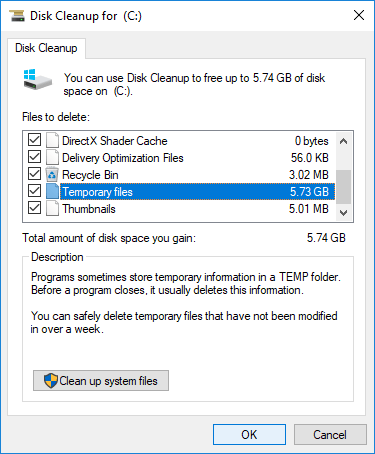
Step 4: Click Delete Files to confirm.
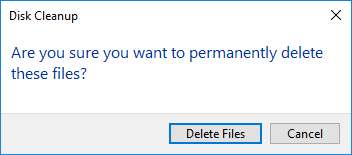
Disk Cleanup will begin clearing up; the time it takes depends on your computer's performance and the number of files.
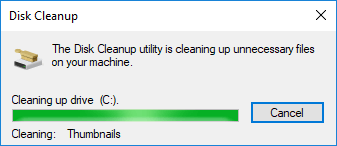
Step 5: Repeat to clear up system files (optional).
If you have never freed up disk space on Windows 10, you may get over 10GB of unused space for the C drive. If you cannot reclaim enough free disk space, there are two options for you:
- Expand the C drive by transferring unused space from another volume. - It is fast, and there is free partition editor software, as shown below.
- Move some files from the C drive to another place safely. - It takes more time and requires a removable device.
2. Modify Settings to Transfer and Save New Files
Move Installed Apps and Games
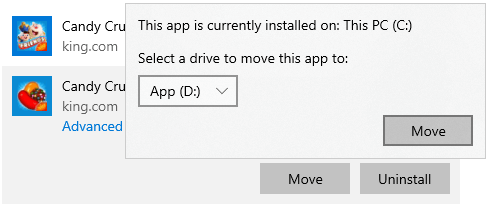
All programs are installed to the system C: drive by default if you do not change the path manually, so the more programs you install, the less free space is left. It is better to install programs to another volume such as D. Windows 10 has the ability to move non-essential programs to another volume directly without reinstalling.
Follow the steps:
- Press the Windows and X keys on the keyboard, then click Settings > Apps > Apps & features
- Click an app or game.
- Click the Move button.
- Select the new location from the drop-down list.
- Click the Move button.
- Repeat the steps to move more items.
Move Files/Folders
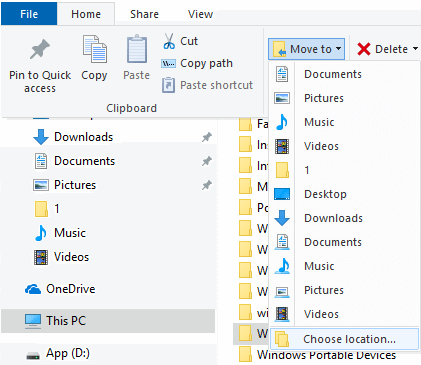
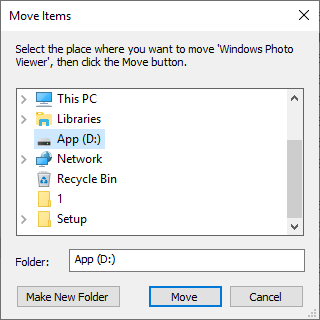
Another option is moving specific files/folders to another volume. Steps:
- Open Windows File Explorer.
- Select the files/folders that you want to move.
- Click the Home menu on the top > Move to > Choose location.
- Click the Move button.
Save Files to a New Location
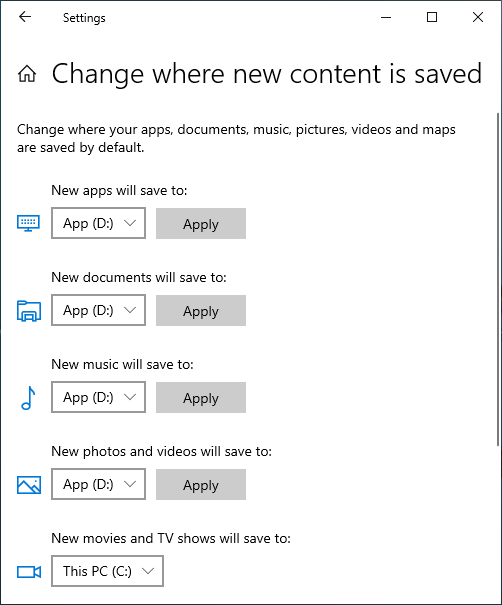
Some programs produce a large amount of files. If you cannot move them to another partition, Windows 10 has a new option to change where new content is saved for apps, documents, music, pictures, and videos to another location. Steps:
- Press the Windows and X keys on the keyboard, then click Settings
- Click System> Storage.
- Click Change where new content is saved under More storage settings.
- Click the drop-down list to select a new location and click Apply.
3. Set to Free Up Disk Space Automatically
Storage Sense is a relatively new feature in Windows 10 that users may enable to free up disk space automatically when the drive is running low on space.
Firstly, you need to enable this service:
- Press the Windows and X keys on the keyboard, then click Settings
- Go to System > Storage
- Toggle Storage Sense from Off to On on the right side.
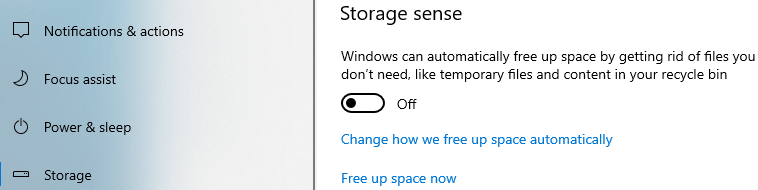
Then click Change how we free up space automatically below it.
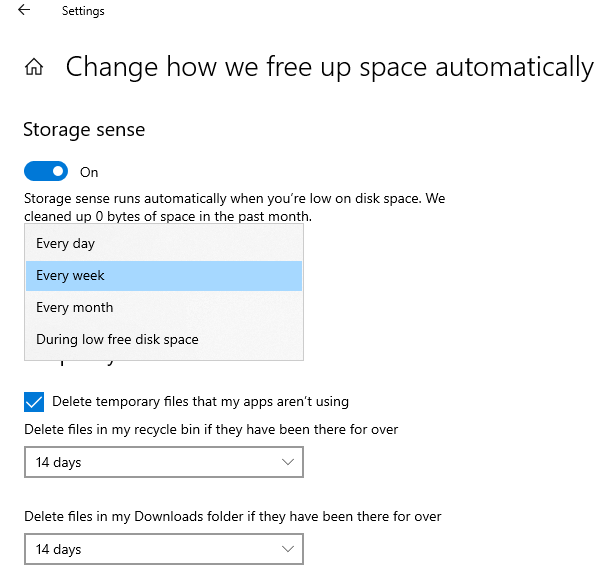
You have several options:
Firstly, select from the list to free up disk space when this partition is running low or every day/week/month.
Then you can select whether to delete temporary files automatically.
Then select from the drop-down list to delete files in the Recycle Bin and Downloads folder if they have been there for over 1/14/30/60 days.
4. Additional Method to Help Free Up Disk Space
If you need more free space in C drive, there are several additional methods to help free up disk space on Windows 10.
Uninstall Apps
You may uninstall some apps and programs that you no longer use or that came preinstalled on your computer from the manufacturer. Steps:
- Press the Windows and X keys on the keyboard, then click Settings
- Scroll down in Apps & features
- Click the items that you want to remove and click Uninstall.
Reset Recycle Bin
All files that are deleted by pressing DEL without the SHIFT key will go to the Recycle Bin, where you can revert these files to their original location manually if you deleted them by mistake.
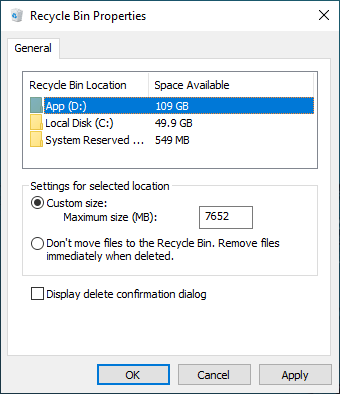
When the system C drive is almost full, you may consider decreasing the disk space or changing the location for the Recycle Bin. Steps:
- Right-click the Recycle Bin on the Desktop and click Properties.
- Select a drive for the Recycle Bin.
- Select Custom size and enter an amount.
Reset Paging File
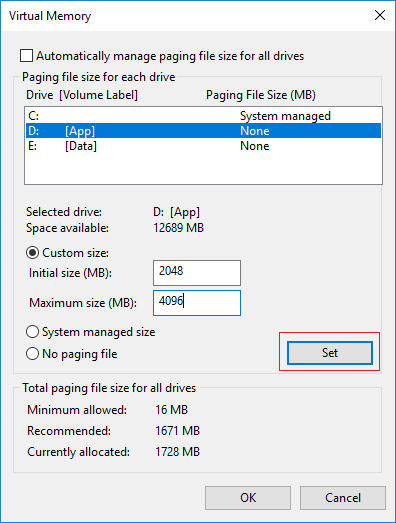
The paging file uses part of the disk space as virtual RAM, and it is located in the C drive by default. You can decrease it or change it to another partition. Steps:
- Press Windows and R on the keyboard to start Run.
- Type sysdm.cpl ,3 and press Enter.
- Click Settings under Performance in the Advanced tab.
- Click Change under Virtual Memory.
- Uncheck Automatically manage paging file size for all drives on the top.
- Select D: or another drive, enter the amount of Initial size and Maximum size in the Custom size radio button, and then click Set.
- Select the C: drive and select the No paging file radio button, then click Set.
- Click OK. (It requires a reboot to take effect.)
Reset System Protection
System Protection is another Windows built-in backup feature that is able to create a system restore point. These restore points are created automatically by Windows when some operations are made to the disk drive, and roll back the system to a recent state when you need. This feature reserves quite a big disk space for its functionality.
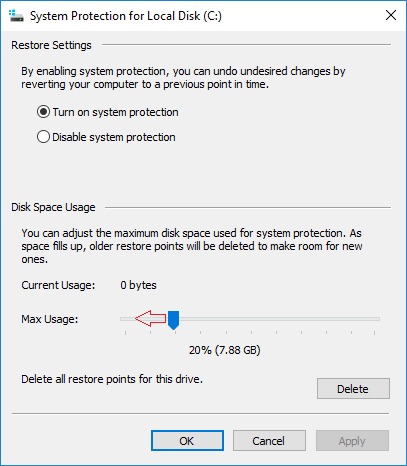
You can free up disk space by reducing disk space usage. Steps:
- Press Windows and R keys to launch Run, type sysdm.cpl ,4 and press Enter.
- Select the C drive and then click Configure
- Slide to the left to decrease the Max Usage of disk space.
Reset Hibernation Setting
Hibernation is a feature that saves the content in memory to the hard drive allowing you to shut down your device completely without losing your current session. Hibernation is a useful feature but it requires several gigabytes of space to save the content to the hiberfil.sys file in the C drive.
You can free up disk space by deleting the hibernation files or reducing the size of hiberfil.sys. Steps:
Search cmd on the task bar on the bottom left corner of the screen, right-click Command Prompt and choose Run as administrator.
To reduce hiberfil.sys file:Type powercfg -h -size 50
The size will be changed from default 75% to the minimum 50%
If you receive an error stating that "The system firmware does not support hibernation", then you cannot use these commands.
To delete hibernate:Type powercfg.exe -h off
Hibernate mode will be disabled and any associated saved data from previous hibernations will be deleted automatically.
If you want to enable it:Type powercfg.exe -h on
Reallocate Space to C Drive
This method is not used to free up disk space on Windows 10, but when you cannot get enough free space, it is important to enlarge the C drive, especially for computers where the C drive is small.
With NIUBI Partition Editor, you can reallocate unused space from other partitions without losing data.
Download it and follow the steps in the video to expand the C drive.
 © 2009 - NIUBI Technology All Rights Reserved. |